
'Apolitical' - a rant
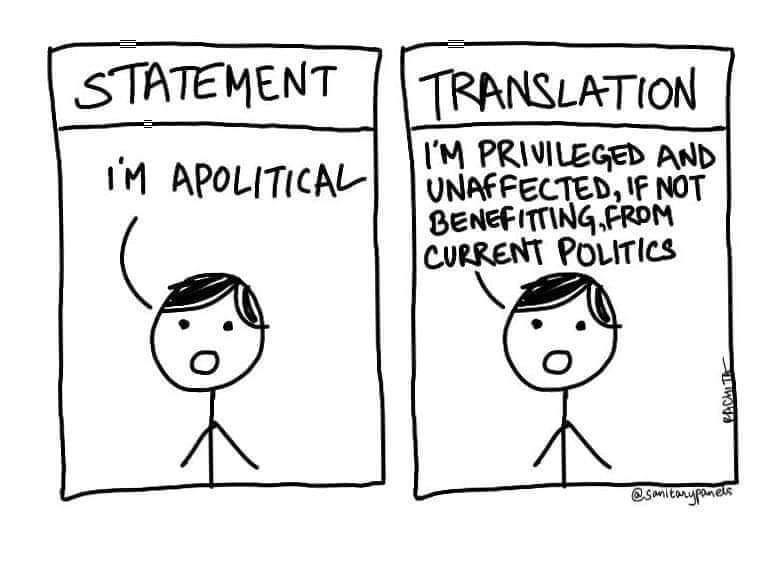
Apolitical is a paradox. We are implicitly taking a political stance when we choose to be apolitical.

“Why so serious?”
“This is too political.”
“Politics is nasty.”
“Why must you kill the vibe, bro?”
“Get a job”
You get where I’m going. It’s a representation of some of the things you hear from good old “neutral” privileged liberal folk. Could be your friends, your family, a random guy passing protest signs on the street. You know, your urban, college educated, ‘live-love-laugh’, reel-making, stocks-investing, podcast-bro-worshipping, vibes over facts generation. Those who pride themselves on opposing hate, but wouldn’t know if fascism came knocking on their doors. Might even invite it in, make it a cup of tea and not make a fuss when it decides to stay indefinitely. “It is what it is”, I guess.
God forbid you say or do anything to harsh their vibe and bring negativity into their lives. And what might this negativity be? Most likely pointing out or asking them to see, acknowledge and speak for the horrible conditions of people around them.
Brains steeped so long in hedonism, liberalism and individual responsibility, it’s hard for them to grasp that their material and social conditions, their everyday life, is a result of the systems that uphold these conditions - favourably for a few and unfairly for most. Systems that we ourselves are complicit in preserving - sometimes under the guise of tradition and sometimes because we’re just unimaginative. Schooling never bothered to equip us with the tools to envision and forge a different world. It was only meant to teach you what the world is, how it works, how to uphold the status quo and why it’s important to do so.
Most of these ‘well-meaning’ folk even seem to show a basic understanding of hate and inequality and how it is used by religion, corporations and political parties for selfish motives. But their response is to disengage, because politics has a bad ring to it. It’s to wipe away all the negativity, renounce responsibility and reinforce a framework which individualises it. Each to their own in this dog-eat-dog world. All of that manifests in so many annoying ways. Some harmful and some designed for self-validation. Both-siding issues, positivity quotes, history revisionism, donating to an animal shelter, tipping, joining an ‘exposure tour’ to a village - anything to bash all this cognitive dissonance out of their heads. (This is not a value judgement on all of these things; like donating your time or money are great things to do. But I will confidently value judge both-siding issues where there are clear dynamics of oppression.)
Privilege
Where does this lack of responsibility come from? Privilege, maybe? A position of privilege where your life is materially unaffected by the political winds of the day. You can still afford your lattes and flat whites, quit your job and explore yourselves, attend concerts high and sweaty, start a podcast about the most inane things and take vacations to the most exotic locations. You can still feast on the fanciest steaks with zero fear. (Again, none of these things are bad in itself. The question is why must only a few be able to do this.)
Privilege that starts from something completely arbitrary in nature - who you’re born to - which goes on to have a cascading effect on every little detail in your life. Where you live, who your friends are, what you do for a living, how rich you are and how disconnected you can afford to be. Your ethnicity, caste, religion and wealth, each prescribes a certain degree of privilege (or lack of it) to you.
Recognizing this privilege is important. Recognizing the absurdity of it, the complete arbitrary nature of it, is as important.
Caught in the system
Privilege doesn’t necessarily lead to an apolitical disposition, nor is it the only way to cultivate that mentality.
We all live in a system that conditions us to be apolitical. Not just those of us who can afford to not care, even those of us who bear the burden of the system. We navigate a capitalist system that incentivises us to shut off, keep your head down and continue grinding, because only then will you be able to afford basic human necessities of life. It demands that you isolate yourself from “troublemakers” who dare to stand up to the system.
It also demands that you preserve your mental health by doing so. The biggest disservice to mental health has been its capitalist takeover. It has been individualised to the extent that each individual becomes both the source and solution to all your mental health issues. Therapy has become solely about ‘coping’ with the stresses of daily life, completely avoidant of exploring why these stresses exist in the first place. We exist in a system that not only creates everyday stress, but burdens a lot of us with generational trauma as well. There is no dearth of mental health influences on social media today. But a few free therapy sessions or mental health tips are not going to solve the issues of a severely overexploited, underpaid and economically deprived population.
Trendy politics
Many among us are conveniently political. We still believe we are vanguards against injustice and are capable of standing up to fight against cruelty and injustice. Especially when it is trendy to do so. And what decides when something becomes trendy?
Social media and mainstream media discourse tends to be hijacked by those with access. Issues that affect us, the privileged, take up way more space than the harsh everyday realities of those without access. Their issues tend to be treated as just the way things are. Mainstream media is owned, operated and populated by those enjoying the fruits of privilege like us. And issues that shock our psyche and threaten our life of comfort get more coverage.
A couple of recent examples will help illustrate this. The rape of a doctor in Kolkata dominated headlines for weeks and took up more physical and media space than the rape of a dalit girl in Bihar that occurred around the same time. More recently, the unfortunate death of an EY employee due to excessive work stress suddenly awakened our communities to India’s toxic work culture. This while millions of low wage manual labour workers endure toxic and inhumane work conditions everyday, but their condition is accepted as ‘ normal’. A poisonous mix of caste and capitalism diminishes the value of their labour for our benefit, forcing them to accept their hardships, while we step back and pretend nothing can be done.
In conclusion
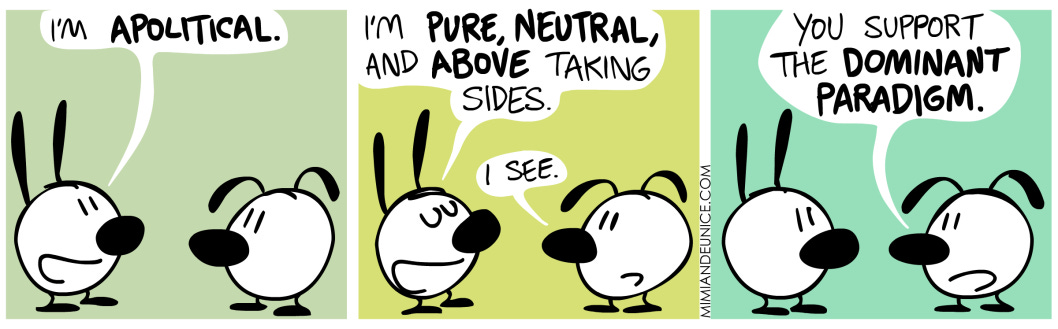
Apolitical is a paradox. Each of us is a political being that comes with our own prejudices that shape the way we see the world. We are implicitly taking a political stance when we choose to be apolitical; the political stance of protecting the status quo. A status quo that doesn’t work for most people living in the world today. A status quo that preserves the privileges we enjoy at the expense of someone else. It might be tempting to think that by choosing to disengage you’re taking a neutral stance and not doing any harm. But there is a cost and someone else always bears it.
What can be done? I don’t have an exhaustive list but a couple of suggestions. Educate ourselves beyond the content that serves to confirm our biases. Understand that all of our struggles are not isolated but intricately tied to each other. They interact and overlap to create complex systems of oppression and privilege. That realization, the collective consciousness it builds and the collective action it can lead to is the biggest threat to the status quo.
Such a great essay!